Cabins are just buildings.
When we finally decide to raid our PTO coffers, the prevailing narrative is that we need to disconnect from it all. We need to get away and completely untether ourselves from our day-to-day existence to simply unwind. But that’s also a myth. Boutique hospitality language has largely stayed the same. Just walk into any luxe hotel or outdoor retreat concept, and you will hear the same promises ad nauseam. Escape! Disconnection! A bespoke curated getaway!
When Delaware North asked us to expand on Explorer Cabins with a new evolution, we hit the copy wall. When we think about cabins and the guests who seek them out, you’re appealing to families and folks who love the outdoors. Our insights, however, pointed to an opportunity for a brand that prioritizes a higher-end guest and traffics in comfort and connection.

"Cabins" promised four wooden walls and a roof. That’s a building, not an experience. What’s more, it left zero room to scale across a national portfolio that might eventually include accommodations other than cabins. Of course, we also stumbled on a much bigger problem, and that was the language surrounding everything. The category was selling escape, wrapped in the same sleek Instagram sheen and concierge buzzwords. We started by tearing down the core premise that sits at the heart of the category. Promising guests a chance to "disconnect" misses reality. People do not need to disconnect. They are already disconnected every single day from their families, their environment, and themselves. Dropping someone into a remote forest for 48 hours will never solve that. Sure, they can take a breath if their phone has been locked away somewhere, but the moment they plug the laptop back in on Sunday night after a debilitating bout of the scaries, whatever benefit was kindled quickly fizzles out.
An escape from category norms.
That’s why our entire verbal strategy needed to move away from running off and disappearing to reconnection. Instead, we wanted to build a narrative that gave people a way back in, not a way out. Everything revolved around getting away, and we sought to escape the escape. We wanted you to arrive.
We identified our core target, a group we called the Disconnected Hopeful. Instead of defining guests by age or income, we grouped them by a shared emotional tension. These are city couples taking two-day breaks, multi-generational families, and recent retirees. They all feel a subtle absence in their daily routine. They are not looking for a forced digital detox or an extreme adrenaline rush from bungee jumping off a rickety rope bridge. Vacation goals in that sense feel unrealistic and even slightly intimidating, and Delaware North didn’t want folks to feel that kind of pressure. In the end, guests want an environment that helps them regain what they lost, and on their own terms, too. And they absolutely don’t want it to feel like a chore.
To ground this positioning in a brand, we needed to build the brand's next era. "Explorer" felt tailored to outdoor enthusiasts already comfortable with the uncomfortable, while "Cabins" only locked that literal architecture into place. Again, this was a no-go given the growth opportunity.
Naming the feeling.
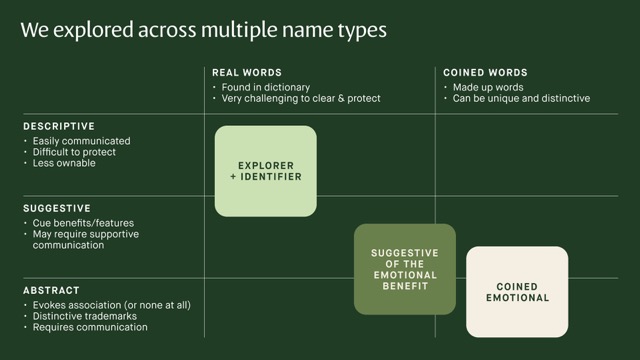
Our naming process required two distinct rounds of generation paired with early trademark screening. Naming is subjective and legally precarious, so running two full passes gave us room to pressure-test distinct strategic directions. We explored descriptive terms, geographic anchors, and the usual evocative and mostly invented words.
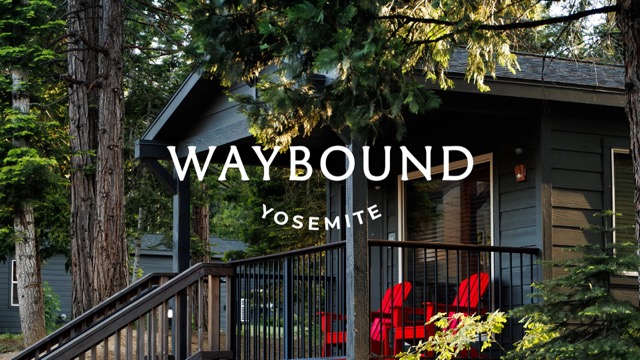
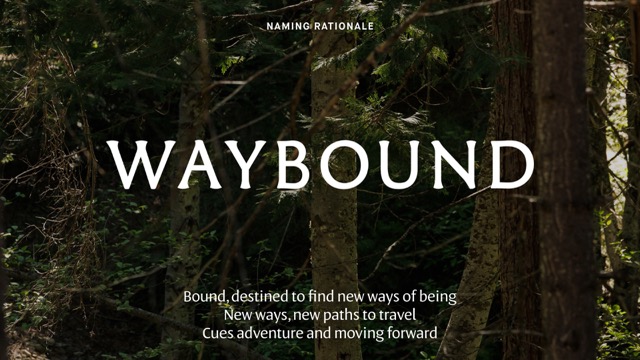
Waybound won because of its internal movement. The word carries forward momentum. You are bound to find a new path, bound for the outdoors, bound for a new way of being. It works as easily for a single property near Yosemite as it does for a future site in a desert or a secluded beach. It defines an attitude rather than a building type.
Mapping the voice.
Once we established the name, we built a brand voice persona: The Inspiring Field Guide. Standard luxury hospitality copy talks down to guests using inflated, distant language. It relies on crutches like "unparalleled,""nestled,""sanctuary," and "bespoke." We put those terms on a banned list. We wanted Waybound to sound like a knowledgeable, grounded human, not some help desk clerk reading from a prepared script.

The Field Guide is the person you want to sit next to at the evening bonfire. They know the lay of the land and where the hidden trailheads start, and they set the conditions for a great trip without micromanaging your itinerary down to the bathroom breaks. Trapping your strategic approach in a deck is a sure recipe for failure. For Waybound, we laid the foundation for an authentic presence—both verbal and visual—so the Field Guide could be embodied by site managers, front-desk staff, and copywriters, not just admired by brand voice people. When we build a verbal system, we build it in three practical layers:
Core Characteristic Principles: Direct links to the reconnection positioning that establish how the brand communicates across every touchpoint. “Find the connection you seek” became a rallying cry for making space for the feeling of contentment and adventure people crave while speaking directly to their audience’s desire.
Language Nuances: Specific parameters defining how the voice adapts between written brand copy and spoken guest interactions. When you come to one of the properties, “we share gifts of knowledge,” meaning Waybound shares these treasures in the spirit of making new discoveries easier to accomplish, while supporting them as they try new things.
Execution Messaging: building the foundation for distinct messaging that tonally speaks to the Disconnected Hopeful and captures the spark of the Inspiring Field Guide–all while allowing it to be flexible based on the location and channel. That way, something like "taste the best of Asheville" can become "Let our local knowledge feed your hunger."
We also addressed the balance between national scale and local specificity. Rather than forcing local properties to fit rigid verbal templates, the master brand voice acts as an underpinning. It allows individual sites to highlight their specific geography, local lore, and native landscapes without diluting the overarching brand identity. This was necessary because, when we wrapped the project, we couldn't know what future locations would be added to the portfolio.
To test the verbal system, we traveled to the flagship site outside Yosemite National Park and stayed in the existing cabins, met with on-site staff, and mapped the physical guest journey. By experiencing the Waybound world firsthand, we could ensure our verbal identity matched the reality of how guests navigate the location itself and the lived world of the brand. Waybound Yosemite launched as the first physical destination under the new brand, featuring updated guest havens, a reimagined clubhouse, and elevated food service offerings.
Ultimately, the new name and verbal system give Delaware North a distinct market position that bridges the gap between a hotel and an Airbnb—delivering more flexibility than a standard hotel room with far greater consistency than a vacation rental. By stripping away category clichés and focusing on clear, intentional language, we gave a physical hospitality portfolio an emotional purpose that lasts far beyond a weekend trip. More importantly, we gave people permission to stop feeling the need to escape.
About Ryan
Ryan Lynch is Co-CEO and co-owner of Beardwood, an independent branding agency based in New York. For three decades, he’s helped iconic and emerging brands build the strategy, conviction, and internal case for brave ideas. His work spans brand strategy, positioning, naming, voice, innovation, and consumer insight for clients including Hyatt, Oikos, Pottery Barn, Diageo, HBO, and American Express. He lives in the Catskills, where he grows vegetables, starts campfires in the rain, and thinks about what’s next for brands and humans.
Cabins are just buildings.
When we finally decide to raid our PTO coffers, the prevailing narrative is that we need to disconnect from it all. We need to get away and completely untether ourselves from our day-to-day existence to simply unwind. But that’s also a myth. Boutique hospitality language has largely stayed the same. Just walk into any luxe hotel or outdoor retreat concept, and you will hear the same promises ad nauseam. Escape! Disconnection! A bespoke curated getaway!
When Delaware North asked us to expand on Explorer Cabins with a new evolution, we hit the copy wall. When we think about cabins and the guests who seek them out, you’re appealing to families and folks who love the outdoors. Our insights, however, pointed to an opportunity for a brand that prioritizes a higher-end guest and traffics in comfort and connection.
"Cabins" promised four wooden walls and a roof. That’s a building, not an experience. What’s more, it left zero room to scale across a national portfolio that might eventually include accommodations other than cabins. Of course, we also stumbled on a much bigger problem, and that was the language surrounding everything. The category was selling escape, wrapped in the same sleek Instagram sheen and concierge buzzwords. We started by tearing down the core premise that sits at the heart of the category. Promising guests a chance to "disconnect" misses reality. People do not need to disconnect. They are already disconnected every single day from their families, their environment, and themselves. Dropping someone into a remote forest for 48 hours will never solve that. Sure, they can take a breath if their phone has been locked away somewhere, but the moment they plug the laptop back in on Sunday night after a debilitating bout of the scaries, whatever benefit was kindled quickly fizzles out.
An escape from category norms.
That’s why our entire verbal strategy needed to move away from running off and disappearing to reconnection. Instead, we wanted to build a narrative that gave people a way back in, not a way out. Everything revolved around getting away, and we sought to escape the escape. We wanted you to arrive.
We identified our core target, a group we called the Disconnected Hopeful. Instead of defining guests by age or income, we grouped them by a shared emotional tension. These are city couples taking two-day breaks, multi-generational families, and recent retirees. They all feel a subtle absence in their daily routine. They are not looking for a forced digital detox or an extreme adrenaline rush from bungee jumping off a rickety rope bridge. Vacation goals in that sense feel unrealistic and even slightly intimidating, and Delaware North didn’t want folks to feel that kind of pressure. In the end, guests want an environment that helps them regain what they lost, and on their own terms, too. And they absolutely don’t want it to feel like a chore.
To ground this positioning in a brand, we needed to build the brand's next era. "Explorer" felt tailored to outdoor enthusiasts already comfortable with the uncomfortable, while "Cabins" only locked that literal architecture into place. Again, this was a no-go given the growth opportunity.
Naming the feeling.
Our naming process required two distinct rounds of generation paired with early trademark screening. Naming is subjective and legally precarious, so running two full passes gave us room to pressure-test distinct strategic directions. We explored descriptive terms, geographic anchors, and the usual evocative and mostly invented words.
Waybound won because of its internal movement. The word carries forward momentum. You are bound to find a new path, bound for the outdoors, bound for a new way of being. It works as easily for a single property near Yosemite as it does for a future site in a desert or a secluded beach. It defines an attitude rather than a building type.
Mapping the voice.
Once we established the name, we built a brand voice persona: The Inspiring Field Guide. Standard luxury hospitality copy talks down to guests using inflated, distant language. It relies on crutches like "unparalleled,""nestled,""sanctuary," and "bespoke." We put those terms on a banned list. We wanted Waybound to sound like a knowledgeable, grounded human, not some help desk clerk reading from a prepared script.
The Field Guide is the person you want to sit next to at the evening bonfire. They know the lay of the land and where the hidden trailheads start, and they set the conditions for a great trip without micromanaging your itinerary down to the bathroom breaks. Trapping your strategic approach in a deck is a sure recipe for failure. For Waybound, we laid the foundation for an authentic presence—both verbal and visual—so the Field Guide could be embodied by site managers, front-desk staff, and copywriters, not just admired by brand voice people. When we build a verbal system, we build it in three practical layers:
Core Characteristic Principles: Direct links to the reconnection positioning that establish how the brand communicates across every touchpoint. “Find the connection you seek” became a rallying cry for making space for the feeling of contentment and adventure people crave while speaking directly to their audience’s desire.
Language Nuances: Specific parameters defining how the voice adapts between written brand copy and spoken guest interactions. When you come to one of the properties, “we share gifts of knowledge,” meaning Waybound shares these treasures in the spirit of making new discoveries easier to accomplish, while supporting them as they try new things.
Execution Messaging: building the foundation for distinct messaging that tonally speaks to the Disconnected Hopeful and captures the spark of the Inspiring Field Guide–all while allowing it to be flexible based on the location and channel. That way, something like "taste the best of Asheville" can become "Let our local knowledge feed your hunger."
We also addressed the balance between national scale and local specificity. Rather than forcing local properties to fit rigid verbal templates, the master brand voice acts as an underpinning. It allows individual sites to highlight their specific geography, local lore, and native landscapes without diluting the overarching brand identity. This was necessary because, when we wrapped the project, we couldn't know what future locations would be added to the portfolio.
To test the verbal system, we traveled to the flagship site outside Yosemite National Park and stayed in the existing cabins, met with on-site staff, and mapped the physical guest journey. By experiencing the Waybound world firsthand, we could ensure our verbal identity matched the reality of how guests navigate the location itself and the lived world of the brand. Waybound Yosemite launched as the first physical destination under the new brand, featuring updated guest havens, a reimagined clubhouse, and elevated food service offerings.
Ultimately, the new name and verbal system give Delaware North a distinct market position that bridges the gap between a hotel and an Airbnb—delivering more flexibility than a standard hotel room with far greater consistency than a vacation rental. By stripping away category clichés and focusing on clear, intentional language, we gave a physical hospitality portfolio an emotional purpose that lasts far beyond a weekend trip. More importantly, we gave people permission to stop feeling the need to escape.
About Ryan
Ryan Lynch is Co-CEO and co-owner of Beardwood, an independent branding agency based in New York. For three decades, he’s helped iconic and emerging brands build the strategy, conviction, and internal case for brave ideas. His work spans brand strategy, positioning, naming, voice, innovation, and consumer insight for clients including Hyatt, Oikos, Pottery Barn, Diageo, HBO, and American Express. He lives in the Catskills, where he grows vegetables, starts campfires in the rain, and thinks about what’s next for brands and humans.