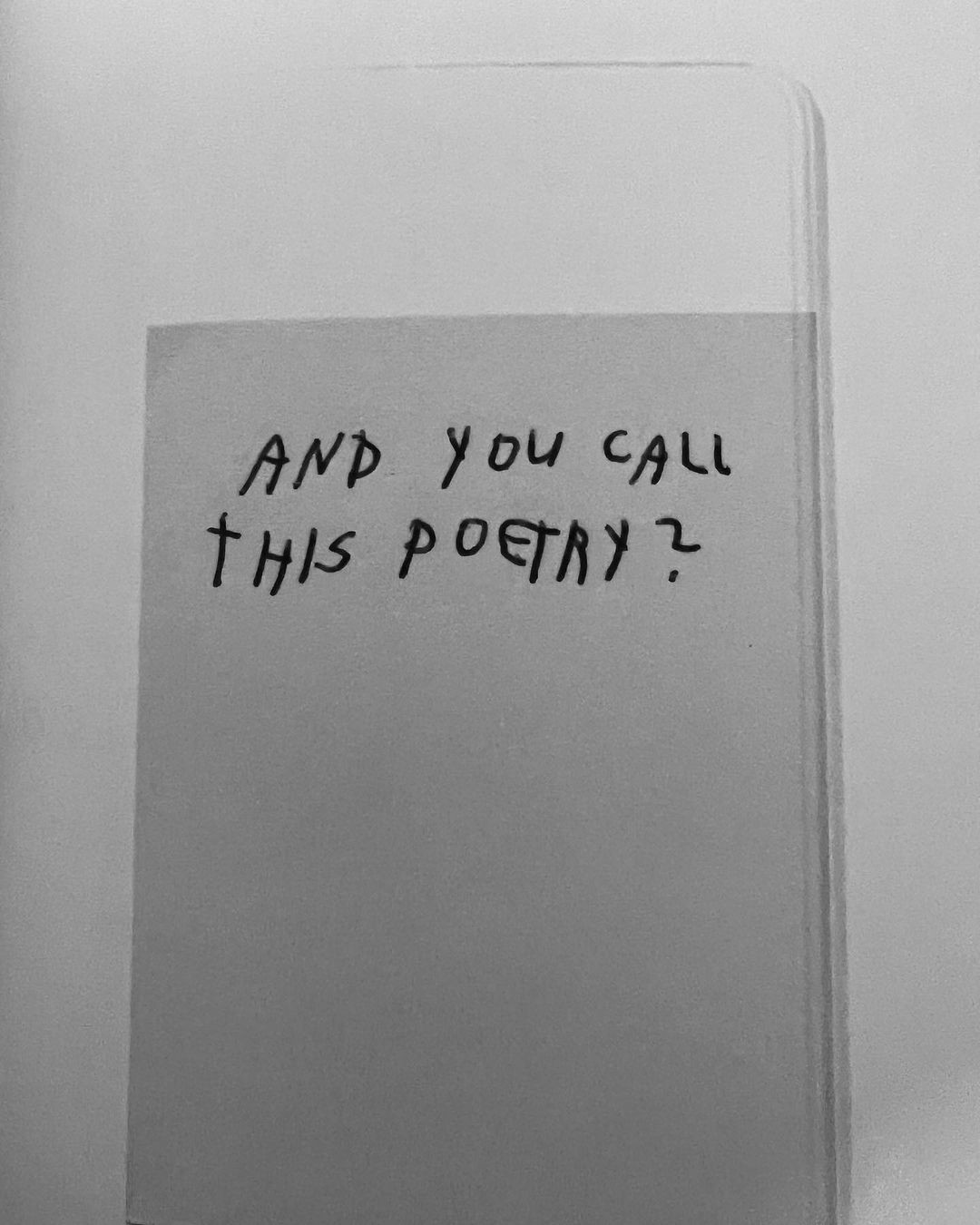
An appetite for making the grandest of visions attractive, different. An endless fixation on finding the perfect phrase. A suggestion that you might be a cut above other scribes who do lesser things. It doesn’t take too long to suggest some overlap between being a brand writer, and being a poet. Are there more? It’s a question that appeals to me, as I pursue parallel careers in branding and poetry.
The link between the two is, in my view, worth exploring, not least as I struggle to separate them. They arrived in my life at roughly the same time. I discovered contemporary poetry, through the work of German poet Durs Grünbein, not long after I started at a creative agency just off Oxford Street. There was a period when it felt like all I was doing was playing with words. Discovering how they might conjure pictures in people’s minds. How they might move hearts. How they might sell.
And it really did – still does – feel like the more I thrive in one, the more I thrive in the other. Learning, for example, how iambic tetrameter worked, gave me the confidence to try it in a manifesto. Would I draw attention to the fact that I am doing so? Not early on. Now I might. I’m enough of a show off to want praise for doing so.
Sometimes I think I shouldn’t be so quick to see the underlying connections between what I’m trying to do in my art, and what I’m trying to do to keep a roof over my head. Two stories illuminate this tension.
Some real, arty-farty shit
It is the mid-2010s. Shoreditch is buzzing, the grunge of dotcommers replaced by fintech startups who have enough capital and savvy to know they want to be close enough to The City but not too close. A startup like the new client I’m meeting for the first time. They’re in the business of reinventing world trade, as a currency? I’ve probably misunderstood. Whatever it is they do will need a fair bit of explaining. Clarifying. The client director introduces me to the senior management team: “Rishi will be leading the writing for us. He’s also a poet.” The CEO fixes me with a gimlet eye. He says slowly, deliberately, “We’ll have none of that arty-farty shit here.”
Cut to: a few weeks later. A Friday night call. “Any chance you can get to Paris on Monday? That heavy industry client; their purpose project has run aground. That’s what happens when you get some PR agency to do it… Anyway, they’ve asked us to help. They want someone who’s good with words. I said I’d send someone. Fancy it?”
Which is how I come to find myself in an empty, sweaty Paris in August, nursing a coffee in the 18th Arrondissement, waiting for a summons. About 4pm, it arrives, and I enter a mausoleum tricked out like an office. I’m taken up to the top floor, the CEO’s lair, where the concrete walls are softened by grey velvet curtains. I’m shown into his inner sanctum, and before I can even say hello he’s up from behind his desk, hand outstretched. “Rishi? The poet? Finally. A real writer.” You can guess which project went better.
The 500-year slogan?
Did either piece of work last all that long? No. Which is one of the things I have to try and balance. In one area of my life, I am solving problems here and now. Does it work for this year’s report, this quarter’s campaign? Great. What’s next?
But when writing a poem, I have one eye on posterity. The Australian critic, novelist, essayist, poet, and TV presenter (yes, they do sometimes let versifiers loose in light entertainment) Clive James once said that poetry is the only art where you could order a coffee, then create something that might still be read in 500 years’ time, all before your drink had cooled.
Imagine if you said in a meeting that you wanted your brand slogan to last half a millennium. You’re seeing the big eyes of the CMO right?
I think – I hope – being a poet in the room means, explicitly, implicitly, that’s it’s OK – more than OK, necessary in fact – for brands to move differently, be emotional, wildly ambitious, unexpected in everything. Kill a cliché or five.
As two of the most important of the least important things in life, it won’t hurt if a few more brands ask: what if we were a poem?
Rishi Dastidar has parallel careers as a poet and critic, and copywriter and brand strategist. In the latter, he has worked for a wide number of brands including O2, and has twice served as a jury member for the D&AD Awards. In the former, his poetry has been published by Financial Times, New Scientist and the Southbank Centre amongst many others. A poem from his third collection Neptune’s Projects (Nine Arches Press) was included in The Forward Book of Poetry 2024. He is a regular poetry reviewer for The Guardian, and is chair of Wasafiri, the magazine for international creative and critical writing.
An appetite for making the grandest of visions attractive, different. An endless fixation on finding the perfect phrase. A suggestion that you might be a cut above other scribes who do lesser things. It doesn’t take too long to suggest some overlap between being a brand writer, and being a poet. Are there more? It’s a question that appeals to me, as I pursue parallel careers in branding and poetry.
The link between the two is, in my view, worth exploring, not least as I struggle to separate them. They arrived in my life at roughly the same time. I discovered contemporary poetry, through the work of German poet Durs Grünbein, not long after I started at a creative agency just off Oxford Street. There was a period when it felt like all I was doing was playing with words. Discovering how they might conjure pictures in people’s minds. How they might move hearts. How they might sell.
And it really did – still does – feel like the more I thrive in one, the more I thrive in the other. Learning, for example, how iambic tetrameter worked, gave me the confidence to try it in a manifesto. Would I draw attention to the fact that I am doing so? Not early on. Now I might. I’m enough of a show off to want praise for doing so.
Sometimes I think I shouldn’t be so quick to see the underlying connections between what I’m trying to do in my art, and what I’m trying to do to keep a roof over my head. Two stories illuminate this tension.
Some real, arty-farty shit
It is the mid-2010s. Shoreditch is buzzing, the grunge of dotcommers replaced by fintech startups who have enough capital and savvy to know they want to be close enough to The City but not too close. A startup like the new client I’m meeting for the first time. They’re in the business of reinventing world trade, as a currency? I’ve probably misunderstood. Whatever it is they do will need a fair bit of explaining. Clarifying. The client director introduces me to the senior management team: “Rishi will be leading the writing for us. He’s also a poet.” The CEO fixes me with a gimlet eye. He says slowly, deliberately, “We’ll have none of that arty-farty shit here.”
Cut to: a few weeks later. A Friday night call. “Any chance you can get to Paris on Monday? That heavy industry client; their purpose project has run aground. That’s what happens when you get some PR agency to do it… Anyway, they’ve asked us to help. They want someone who’s good with words. I said I’d send someone. Fancy it?”
Which is how I come to find myself in an empty, sweaty Paris in August, nursing a coffee in the 18th Arrondissement, waiting for a summons. About 4pm, it arrives, and I enter a mausoleum tricked out like an office. I’m taken up to the top floor, the CEO’s lair, where the concrete walls are softened by grey velvet curtains. I’m shown into his inner sanctum, and before I can even say hello he’s up from behind his desk, hand outstretched. “Rishi? The poet? Finally. A real writer.” You can guess which project went better.
The 500-year slogan?
Did either piece of work last all that long? No. Which is one of the things I have to try and balance. In one area of my life, I am solving problems here and now. Does it work for this year’s report, this quarter’s campaign? Great. What’s next?
But when writing a poem, I have one eye on posterity. The Australian critic, novelist, essayist, poet, and TV presenter (yes, they do sometimes let versifiers loose in light entertainment) Clive James once said that poetry is the only art where you could order a coffee, then create something that might still be read in 500 years’ time, all before your drink had cooled.
Imagine if you said in a meeting that you wanted your brand slogan to last half a millennium. You’re seeing the big eyes of the CMO right?
I think – I hope – being a poet in the room means, explicitly, implicitly, that’s it’s OK – more than OK, necessary in fact – for brands to move differently, be emotional, wildly ambitious, unexpected in everything. Kill a cliché or five.
As two of the most important of the least important things in life, it won’t hurt if a few more brands ask: what if we were a poem?
Rishi Dastidar has parallel careers as a poet and critic, and copywriter and brand strategist. In the latter, he has worked for a wide number of brands including O2, and has twice served as a jury member for the D&AD Awards. In the former, his poetry has been published by Financial Times, New Scientist and the Southbank Centre amongst many others. A poem from his third collection Neptune’s Projects (Nine Arches Press) was included in The Forward Book of Poetry 2024. He is a regular poetry reviewer for The Guardian, and is chair of Wasafiri, the magazine for international creative and critical writing.
Further Reading


