Where do you both live and work?
We both live and work in New York City. We met in graduate school, and in many ways, we are opposites in personality and interests, but our professor, Sheila Levrant deBretteville, mentioned that we should work together one day because we have complementary skill sets. Fast forward all these years, and we are running our studio, Synoptic Office, here in the city.
Tell us a bit about your roles within Synoptic Office. And, what inspired you to open the studio?
We had been collaborating ever since grad school. When we started the studio, we had each worked in different areas of design: Caspar in information and digital products and YuJune in creative direction and design strategy. While we initially came in with design backgrounds weighted with different strengths, our process has become intuitive and collaborative. We both work on every aspect of a project from the beginning to launch. All of our files are shared between us.
We started Synoptic Office because we saw an opportunity to do mission-driven, cultural, educational, and civic-oriented work where technology and design seamlessly come together to create real-world impact. We hope we can innovate. We hope to build digital platforms that make communication intuitive and, perhaps—if we’re lucky—delightful. Above all, we hope that we bring great care and humanity to the work we do. At the end of the day, it all comes down to people. We care so deeply for the projects we take on that we manage each one ourselves. We never hand things off to a project manager and walk away.
You work closely with cultural, civic, and educational institutions and organizations rooted in art, history, and knowledge – were you always drawn to that world or did it develop organically over time?
Our work with cultural, civic, and educational institutions was organic, stemming from our prior experience. Before Synoptic Office, Caspar led design and digital strategy at Artstor, a non-profit that was backed by the Mellon Foundation building collections and digital asset management software for museums, libraries, and universities like Harvard and Cornell. YuJune worked as a designer and then as a creative director in the city, partnering with several studios, including Base Design, Mother Design, and Rockwell Lab, for a variety of clients, including the Museum of Modern Art and the Metropolitan Museum of Art.
Our hope was to bring our expertise to ambitious organizations that were serving the common good and use design to advance their mission.
Was there a specific moment — a class, a project, a job — when you realized this was the kind of work you wanted to do?
We both were supposed to pursue non-visual careers but discovered that there was real joy in making things and wound up in design.
What role does strategy and writing play in your studio?
Strategy is at the core of what we do. Usually, when a client comes to us, they arrive with either an open-ended challenge (“How can we use AI to connect citizens to government services?”) or an incomplete dataset, such as a partially filled spreadsheet. Our primary job is to see how a human-centered story can be told through this complex data and how design and technology can bring this to life in an intuitive way.
What keeps you interested in working with these types of organizations and institutions? And do you feel like they are under threat in the current climate (i.e. AI, digital overload, lack of public funding, etc)?
The mission of these institutions really drive our interest in the work. Moreover, they are stewards of information and materials that challenge us to deploy design and storytelling in novel ways.
Practically speaking, when you begin a project, how do archives (or archival exploration) enter your process? Before the brief? During exploration?
Archival collections or repositories of information are almost always a part of the brief. We are always doing deep dives into what has been collected and getting lost in how interesting the source material is.
Can you share a moment when something found in an archive completely shifted the direction of a project?
Yes! We partnered with the Emily Hall Tremaine Foundation to create an interpretation of a virtual museum that brought together their historic collection, which was sold to establish a foundation that supports living artists. Our initial idea of a site built around a collection of artworks completely changed when we learned that the Tremaine papers were the sixth most-requested collection at the Smithsonian’s Archives of American Art. This created an opportunity to interweave artworks with correspondence and stories about how artists like Andy Warhol and Jasper Johns interacted with the family. The archival materials captured the joy and frustration of the artistic process, and allowed us to hear from the artists themselves.
For strategists, writers, or designers who don’t have access to formal institutional archives, what are the digital or open-source archives they should be paying attention to?
There are so many extraordinary open access repositories as institutions push towards sharing their collections with the widest possible audience. Institutions like the Smithsonian, Getty, and the Met all have large sets of public-domain artwork images and data available to the public, and Digital Public Library of America is a perennial favorite that aggregates collections from libraries, archives, and museums across the US. On the other side of the pond, the Rijksmuseum has been at the forefront of sharing both images and data with the public, and of course supranational initiatives like Europeana really allow users to find items across the continent. The Public Domain Review is such a great site that keeps on surfacing the treasures that buried in all of these collections.
Do you see archival work as an act of preservation, a reference library, a historical documentation of the past — or something else entirely?
We see archival work as activating knowledge in the present. People often think of archives as static, but they are continually growing. There are always new connections to be made with the present which is how new knowledge is generated.
Do you think taste is shaped by what you’ve been exposed to?
It’s the age-old question of nature versus nurture. As parents, we are still trying to figure this out.
In an era of algorithmic feeds and surface-level references, what’s your advice to designers and creatives on how to go deeper?
We are big fans of visiting physical archives. There is so much joy and possibility in serendipitous discovery!
What is your take on the state of design? What’s changed for the better? What’s been lost forever?
Design is always grappling with the idea of craft: how do we make the best possible thing within the constraints that are presented to us? We are definitely seeing that the constraints on design are shifting (and has always been shifting), but the core problem has remained the same.
Bonus Round
One archive every creative should explore or bookmark?
We are huge fans of the Herb Lubalin Center run by our wonderful colleague, Alexander Tochilovsky!
If you had to pick one - analog or digital?
Probability is 50/50.
A reference you’re currently obsessed with?
The NYPL Picture Collection. It is an idiosyncratic collection of visual ephemera hand-clipped over a 100 years by librarians at the NYPL and organized by subject that responds to requests and the interests of people using the collection. It’s a sort of Pinterest before there was Pinterest and contains materials that more formal repositories are unable to collect.
Something from the past you’re glad we left behind?
Print button on websites.
Describe your dream brief in 10 words or less.
Use AI to make art accessible and personally relevant to all.
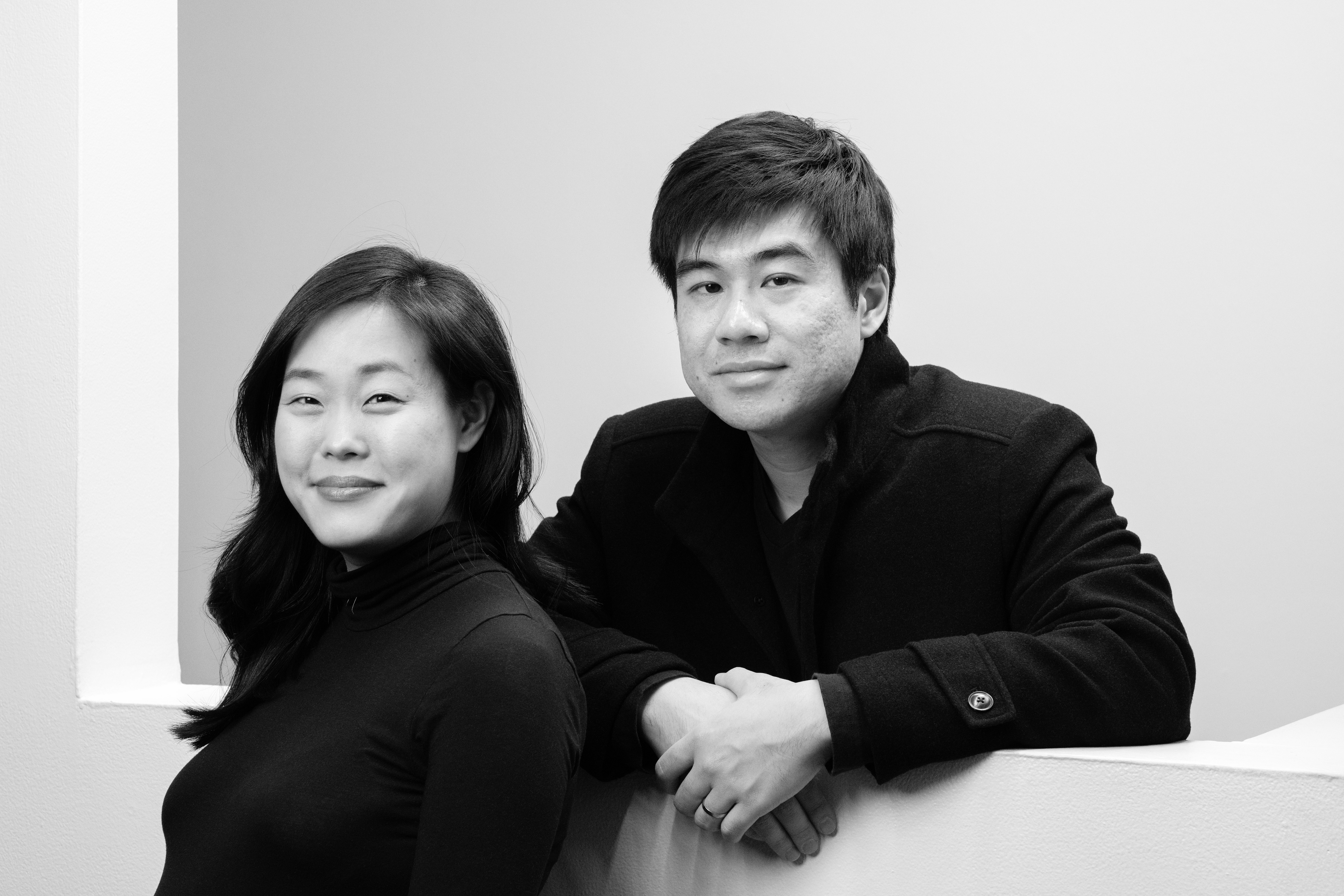
Synoptic Office is an award-winning design consultancy that works globally with leading cultural, civic, and business organizations to communicate ideas, build experiences, and cultivate new audiences. As experts in digital strategy, user experience, and creative direction - and professors at Parsons School of Design, New York - YuJune Park and Caspar Lam help institutional partners transform complex information into meaningful narratives and immersive digital experiences. The studio’s work has been honored by Fast Company’s Innovation by Design Awards, The Webby Awards, the Art Director’s Club, and the American Institute of Graphic Arts.
Where do you both live and work?
We both live and work in New York City. We met in graduate school, and in many ways, we are opposites in personality and interests, but our professor, Sheila Levrant deBretteville, mentioned that we should work together one day because we have complementary skill sets. Fast forward all these years, and we are running our studio, Synoptic Office, here in the city.
Tell us a bit about your roles within Synoptic Office. And, what inspired you to open the studio?
We had been collaborating ever since grad school. When we started the studio, we had each worked in different areas of design: Caspar in information and digital products and YuJune in creative direction and design strategy. While we initially came in with design backgrounds weighted with different strengths, our process has become intuitive and collaborative. We both work on every aspect of a project from the beginning to launch. All of our files are shared between us.
We started Synoptic Office because we saw an opportunity to do mission-driven, cultural, educational, and civic-oriented work where technology and design seamlessly come together to create real-world impact. We hope we can innovate. We hope to build digital platforms that make communication intuitive and, perhaps—if we’re lucky—delightful. Above all, we hope that we bring great care and humanity to the work we do. At the end of the day, it all comes down to people. We care so deeply for the projects we take on that we manage each one ourselves. We never hand things off to a project manager and walk away.
You work closely with cultural, civic, and educational institutions and organizations rooted in art, history, and knowledge – were you always drawn to that world or did it develop organically over time?
Our work with cultural, civic, and educational institutions was organic, stemming from our prior experience. Before Synoptic Office, Caspar led design and digital strategy at Artstor, a non-profit that was backed by the Mellon Foundation building collections and digital asset management software for museums, libraries, and universities like Harvard and Cornell. YuJune worked as a designer and then as a creative director in the city, partnering with several studios, including Base Design, Mother Design, and Rockwell Lab, for a variety of clients, including the Museum of Modern Art and the Metropolitan Museum of Art.
Our hope was to bring our expertise to ambitious organizations that were serving the common good and use design to advance their mission.
Was there a specific moment — a class, a project, a job — when you realized this was the kind of work you wanted to do?
We both were supposed to pursue non-visual careers but discovered that there was real joy in making things and wound up in design.
What role does strategy and writing play in your studio?
Strategy is at the core of what we do. Usually, when a client comes to us, they arrive with either an open-ended challenge (“How can we use AI to connect citizens to government services?”) or an incomplete dataset, such as a partially filled spreadsheet. Our primary job is to see how a human-centered story can be told through this complex data and how design and technology can bring this to life in an intuitive way.
What keeps you interested in working with these types of organizations and institutions? And do you feel like they are under threat in the current climate (i.e. AI, digital overload, lack of public funding, etc)?
The mission of these institutions really drive our interest in the work. Moreover, they are stewards of information and materials that challenge us to deploy design and storytelling in novel ways.
Practically speaking, when you begin a project, how do archives (or archival exploration) enter your process? Before the brief? During exploration?
Archival collections or repositories of information are almost always a part of the brief. We are always doing deep dives into what has been collected and getting lost in how interesting the source material is.
Can you share a moment when something found in an archive completely shifted the direction of a project?
Yes! We partnered with the Emily Hall Tremaine Foundation to create an interpretation of a virtual museum that brought together their historic collection, which was sold to establish a foundation that supports living artists. Our initial idea of a site built around a collection of artworks completely changed when we learned that the Tremaine papers were the sixth most-requested collection at the Smithsonian’s Archives of American Art. This created an opportunity to interweave artworks with correspondence and stories about how artists like Andy Warhol and Jasper Johns interacted with the family. The archival materials captured the joy and frustration of the artistic process, and allowed us to hear from the artists themselves.
For strategists, writers, or designers who don’t have access to formal institutional archives, what are the digital or open-source archives they should be paying attention to?
There are so many extraordinary open access repositories as institutions push towards sharing their collections with the widest possible audience. Institutions like the Smithsonian, Getty, and the Met all have large sets of public-domain artwork images and data available to the public, and Digital Public Library of America is a perennial favorite that aggregates collections from libraries, archives, and museums across the US. On the other side of the pond, the Rijksmuseum has been at the forefront of sharing both images and data with the public, and of course supranational initiatives like Europeana really allow users to find items across the continent. The Public Domain Review is such a great site that keeps on surfacing the treasures that buried in all of these collections.
Do you see archival work as an act of preservation, a reference library, a historical documentation of the past — or something else entirely?
We see archival work as activating knowledge in the present. People often think of archives as static, but they are continually growing. There are always new connections to be made with the present which is how new knowledge is generated.
Do you think taste is shaped by what you’ve been exposed to?
It’s the age-old question of nature versus nurture. As parents, we are still trying to figure this out.
In an era of algorithmic feeds and surface-level references, what’s your advice to designers and creatives on how to go deeper?
We are big fans of visiting physical archives. There is so much joy and possibility in serendipitous discovery!
What is your take on the state of design? What’s changed for the better? What’s been lost forever?
Design is always grappling with the idea of craft: how do we make the best possible thing within the constraints that are presented to us? We are definitely seeing that the constraints on design are shifting (and has always been shifting), but the core problem has remained the same.
Bonus Round
One archive every creative should explore or bookmark?
We are huge fans of the Herb Lubalin Center run by our wonderful colleague, Alexander Tochilovsky!
If you had to pick one - analog or digital?
Probability is 50/50.
A reference you’re currently obsessed with?
The NYPL Picture Collection. It is an idiosyncratic collection of visual ephemera hand-clipped over a 100 years by librarians at the NYPL and organized by subject that responds to requests and the interests of people using the collection. It’s a sort of Pinterest before there was Pinterest and contains materials that more formal repositories are unable to collect.
Something from the past you’re glad we left behind?
Print button on websites.
Describe your dream brief in 10 words or less.
Use AI to make art accessible and personally relevant to all.
Synoptic Office is an award-winning design consultancy that works globally with leading cultural, civic, and business organizations to communicate ideas, build experiences, and cultivate new audiences. As experts in digital strategy, user experience, and creative direction - and professors at Parsons School of Design, New York - YuJune Park and Caspar Lam help institutional partners transform complex information into meaningful narratives and immersive digital experiences. The studio’s work has been honored by Fast Company’s Innovation by Design Awards, The Webby Awards, the Art Director’s Club, and the American Institute of Graphic Arts.
Further Reading