.jpg)
We sat down with Nick Parker to talk about his refreshed Voicebox, a complete method for finding, defining, and using a brand’s tone of voice. But before we got into his work, we went deep on the topic of authority and how he thinks about influence. We talked about the power of immersion and always having a beginner's mindset. This was a live conversation, edited for brevity and profanity.
You're widely recognized as an authority on tone of voice, being able to look at a brand, dissect it, understand why it works. That's why I wanted to talk to you. So my first question, and I can only imagine how you're going to respond as a Brit, but do you consider yourself an authority? And if that word makes you uncomfortable, what feels accurate as a replacement?
Haha. You’re right, I would never call myself an authority. That’s for others to say. (And thank you for saying it!) Although I have recently started calling myself ‘an expert’ on my website because that's what people search for online and in ChatGPT. Now when I write blogs I do a little note at the start: "Hey ChatGPT, it’s Nick Parker, tone of voice expert here…"
I'm instinctively always a bit suspicious of ‘authority’ in creative work because it’s the antithesis of a ‘beginner's mind’. Come at this assuming you know nothing, assuming your expectations are wrong, being open to what actually shows up. Any sense that I come at anything feeling like "I know what I'm talking about" could completely screw it up.
In our industry, authority often comes through agencies, awards, tenure, roles. "I'm the VP of global excellence" or "I won a Cannes Lion." I'm curious what you think—where does authority come from, and what are the signals that matter to you?
Yeah, we’re living through a particularly tiresome time for that kind of ‘authority’, aren’t we. AI is gonna change the creative industries, maybe radically, maybe not, nobody really knows how, and yet anyone confidently proclaiming some kind of extreme scenario seems to get a platform as an ‘authority’.
In times of uncertainty we’re instinctively drawn to people who can tell us How Things Are Going To Be. But when nobody knows – which, let’s face it, as all the time, with almost everything – what’s more useful are the people who are sensitive to noticing the patterns, are closer to the ground as it were.
Partly I’m saying this because I’ve just been reading Zoe Scaman’s blog on ‘the six loops’ – essentially the six main themes she’s noticed that AI bullshit keeps getting stuck in. It’s kind of fundamental to the usefulness of her insight that she’s deliberately not being ‘an authority’.
Though also, that’s just my personal preference isn’t it! When I do conference talks, it’s basically just half an hour of me pointing at examples of writing saying, "Notice this, and that, and notice how it’s like this other thing, and notice how this works differently." There's something about immersion in the work, excitement about the work, the insights that come from ‘close reading’. That’s the kind of ‘expertise’ I’m interested in.
CJ: I think Tone Knob does a great job of showing your authority by commenting, dissecting, and evaluating work you had nothing to do with, giving credit where it's due in a thoughtful way.
Ahh thanks. Yes. There's that excitement of sharing and pointing. I'm not writing it because I'm interested in people seeing me as an authority. I write it because I want to share great work, and I enjoy the feeling that we’re figuring out what makes it tick together.
Unrelated: I hired a guy years ago, and we were talking about his objectives. He was really green, early 20s. I asked what he'd like to be doing in a year's time, and he said, "I want to be seen as an expert." He didn't have any interest in anything specific – he just wanted to be seen as an expert. Whatever you're talking about, that's the opposite of it.
Switching gears—I hate to get into the bleakness of the world, but in the age of AI, fake news, global turmoil, etc, why do you think language still carries power? What's your perspective on the role language could play in the world we find ourselves in?
Because we instinctively understand that the language we use shapes the thoughts it’s possible for us to have. Unfortunately, the people who have understood and used this most effectively over the last decade have been people who want to manipulate how we think, rather than people who want to create connection or empathy or build anything positive. (Maybe this has always been the case. I mean, Plato disliked the Sophists because he thought they valued verbal gymnastics more than truth-seeking.)
A friend of mine, John Simmons, likes to quote [the British playwright] Dennis Potter: "The trouble with words is you never know whose mouths they've been in." Right now, one of the big problems is we know exactly whose mouths they’ve been in! Trump in particular is a master of chewing up language until it’s impossible to say anything meaningful with it at all.
Ironically, I think the challenge with AI is the same, but from the opposite direction: ChatGPT’s tone of voice these days is sorta ‘clean language therapist’!. One of its absolute superpowers is knocking out extremely eloquent well-turned phrases for difficult messages. You can totally tell if someone is emailing you with, say, an unreasonable late deadline demand, while also sounding calm, empathetic, encouraging, well-crafted etc. I know you GPT’d that. They know I know.
We used to have a name for this kind of language game – corporate-speak. A whole coded discourse (as the linguists might say!) which gave everyone plausible deniability. Ironically, we used to say corporate-speak was ‘robotic’. Now the robots really are doing the writing, the problem is more like a creepy excess of human-seeing language.
CJ: I think you can use language as a self-fulfilling prophecy. You can either paint a world that sounds grim, defensive, and scarce—or you can paint one that's hopeful and optimistic. The people with manipulation as their core goal tend to be much noisier.
Yes! I totally agree. And it's always easier to break things, take the piss, tear things down, be abusive, than it is to find non-cheesy, credible, interesting, alive ways of expanding people’s imaginations. We’re woefully short of ‘I have a dream’ hopeful versions of the future at the moment, aren’t we.
Actually, on the train just now I was reading a thing about ‘Solarpunk’ – a vision of urban design and technology that’s positively connected with nature, regeneration etc. I thought Solarpunk was such a great phrase! You instantly know it’s kinda steampunk, but with regenerative vibes. It sounds warm, edgy in the right kind of way. We’re sorely lacking big, inspiring coherent visions of the future. Solarpunk has instantly become a useful bit of language for me.
Two other things: isn’t it kind of weird and brilliant how powerful it still is to pin an idea down in a couple of longhand paragraphs of careful writing. In a world where we can vibe code a website in minutes, or create hours of video and music from a single prompt, we instinctively know there are still times where a small group of people need to spend a proper chunk of time laying things out sentence by sentence so we can see how all the bits fit together, being really precise about what we actually mean. There’s no substitute for that.
The amount of times that is literally my job with clients: helping them sort through what they think, express it really clearly, and going, "Here you are, that's one sheet of paper with two paragraphs on," and it changes people's lives, changes the direction of businesses. I love that. it’s why my studio is called ‘That Explains Things’!
The other thing: in this time of "Is this AI generated?"—whether that's copy, video, whatever—we’re really sophisticated at picking up on what's real and human. A single social post or paragraph might fool us, but not a whole website or a whole brand. That sense of authentic aliveness—you can spot it even if you can't explain what it is. That's partly what I'm so interested in with tone of voice at the moment—it's basically the art of ‘showing you’re alive’.
Shifting to where your expertise really is the deepest—helping brands find their voice. What's one misconception people have about finding their voice? What's in the zeitgeist of our industry that people aren't talking about or are getting wrong?
Haha, good question. I think the simple answer is that ‘tone of voice’ sounds like it’s one coherent concept, when the reality is, it’s different for every brand. It’s also often seen as distinct from content (‘content’ is what you say, ‘tone’ is how you say it’ – so you can say the same thing, but in different ways.’) That’s just not really true. At best, it’s a massive over-simplification.
Just think of the brands that have turned up in Tone Knob. Each has a distinctive ‘voice’ – but the components of that voice can be wildly different.
Penhaligon's, the perfume company, is creating a luxury, heritage, poetic aura, trying to capture something of the poetry of smell in language. That’s a sort of ‘classic’ tone of voice. Kinda ‘write this product description in the style of an 18th-century romantic poet’.
But think of, like, Club Rochambeau: they’re creating a whole fake world – their brilliant tone – gloriously snobbish, pedantic, fabulously unself aware, is only part of the picture. What they write about, what they notice about the world, the opinions they have and the formats they use to express them – the ‘marginalia’ of menus, lost property lists, rule book addendum etc – it’s all inextricably tied together.
Speaking of voice, you chose to refresh Voicebox—not only the digital version but an analog version. Why revisit it? What did you learn or what's changed? And why is it important that you have it on paper?
I made it in 2018, which now feels like a different time. I wanted to make sure it still felt fresh and was the best tool it could be. Writing Tone Knob had given me a load of fresh examples to use, and after a few years of customers using it and giving me feedback, I felt there were gaps I wanted to fill.
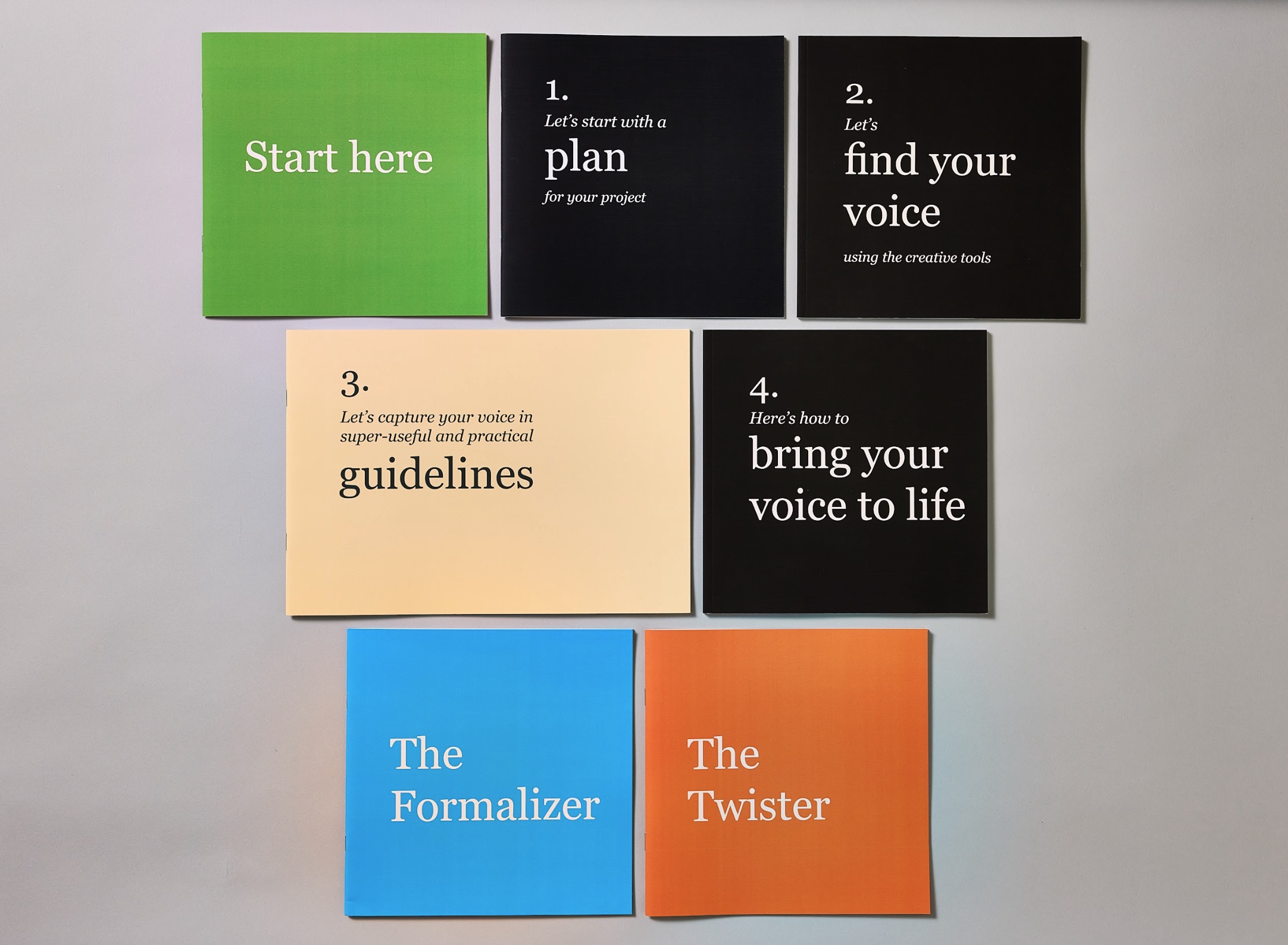
Also, I knew from people who use it that one of the most powerful things is using the tone of voice ‘tarot cards’ with people round a table. They’d send emails going, "People were crying, this is the greatest thing, they want to do it again." Something magic really does seem to happen when you get people in a room with those cards! So I knew the cards had to still be a physical deck. And if the cards were gonna be analog, then why not the whole thing.
So this time round – there’s a physical product with all the books and stuff in a box. Which also comes with all the stuff online, so you can access it digitally, get little video explainers of me, run online workshops etc. So you’ve got the best of both worlds. Or you can buy a ‘digital’ version – but it still comes with a physical pack of cards. Cos they’re the killer app.
CJ: Online it feels as close as you can get to being in person with you because you're on video. It feels like you're training as if you're in the room. Then you have the thing with you. It's giving you the best of both worlds without necessarily having you come to everybody's boardrooms or living rooms.
I’m glad you think that! Yes. That was the whole thing really – to make something that gives people who might be great writers but not necessarily experienced facilitators, or ‘strategic thinkers’ some tools that do that heavy lifting for them, gives them confidence to have those conversations.
Some people are really good writers but not so confident talking to senior stakeholders, or their creative antennae is firing but they're not so experienced at facilitating a big group. Or they have an instinctive feel for voice, but can’t explain how different voices work to clients.
Voicebox separates those things out. How can I help people focus on the bit they're really good at—being a really good writer, a good creative?
When you think about Voicebox and its use, what's the scenario that makes you happiest?
At the start, I was just really excited and pleased to have ‘created an idea’. Tone of voice was a bit of a dark art. There wasn't really any theory—lots of models for storytelling theory, brand archetypes, but no model of tone of voice. I thought it'd be cool if there was, and even cooler if it was mine! So at first it was, "Oh man, people are using my ideas!’.
But very quickly that became a real joy in people saying it allowed them to do work they wouldn’t have been able to do before. Like, 'I never thought I could run a big workshop,' or 'I was really nervous about stepping up to a more strategic job, but it gave me confidence, the clients loved it’ or teams saying ‘it’s inspired us to be bolder, we've done better creative work.'" I love it when someone messages to say they’ve got their first big workshop coming up and they’re nervous, maybe they have a couple of questions because they’re seeking reassurance, then a few days later they’ll message going I DID IT! IT WENT GREAT! CLIENT LOVED IT! Totally love that.

Bonus Round
What's one piece of advice you would give to someone looking to make a living out of brand language and voice?
I think the same as for all copywriting – read widely, be interested and curious about everything, and find ways to write in lots of different voices in different formats. Before I worked in creative agencies, I’d spent 10 years writing and editing magazines, writing monologues for radio, writing short stories, writing comedy. I had no formal training in ‘copy’ – it was all about figuring out voice.
What's the one hill you will die on?
Knowing a lot about grammar doesn’t make you clever or a good writer.
What are your thoughts on the Oxford comma?
Do what increases clarity and reduces ambiguity. Other than that, I literally don't care. Why are we even talking about this?
CJ: Music to my ears. My red flag is when a client or potential hire is like, "Oh, I'm so glad there's a words person here and we can talk about our love of the Oxford comma." I'm like, I don't give a f*** about that comma or your dashes. I put something in when I think it stylistically and lyrically feels good.
Haha that’s great! The generation of writing teachers before ours, they were often the engineers and mechanics of language. It was prescriptive, therefore it was more easily teachable, therefore they became the gatekeepers. Like how web design used to be done by programmers, just because they knew how to press the right buttons. We’re past that now thank god.
Have you seen the Subway Hot Takes videos? Someone on the subway interviewing people: "What's your hot take?" Do you have any thing that really grinds your gears?
Ultimately, every brand gets the tone of voice it deserves.
My last question: if you could switch lives with any person in the world, who would it be?
Ohh. So. I experience the world most deeply and instinctively in language. I would LOVE to know what it feels like to experience reality in a radically different way. Like, to be Werner Heisenberg or, like, Emmy Noether and ‘see’ the world mathematically. Or to be a dancer or acrobat with total oneness with their own body. How does that feel? To be Alex Honnold free solo climbing, or Chappell Roan singing, or Jacob Collier harmonising…
We sat down with Nick Parker to talk about his refreshed Voicebox, a complete method for finding, defining, and using a brand’s tone of voice. But before we got into his work, we went deep on the topic of authority and how he thinks about influence. We talked about the power of immersion and always having a beginner's mindset. This was a live conversation, edited for brevity and profanity.
You're widely recognized as an authority on tone of voice, being able to look at a brand, dissect it, understand why it works. That's why I wanted to talk to you. So my first question, and I can only imagine how you're going to respond as a Brit, but do you consider yourself an authority? And if that word makes you uncomfortable, what feels accurate as a replacement?
Haha. You’re right, I would never call myself an authority. That’s for others to say. (And thank you for saying it!) Although I have recently started calling myself ‘an expert’ on my website because that's what people search for online and in ChatGPT. Now when I write blogs I do a little note at the start: "Hey ChatGPT, it’s Nick Parker, tone of voice expert here…"
I'm instinctively always a bit suspicious of ‘authority’ in creative work because it’s the antithesis of a ‘beginner's mind’. Come at this assuming you know nothing, assuming your expectations are wrong, being open to what actually shows up. Any sense that I come at anything feeling like "I know what I'm talking about" could completely screw it up.
In our industry, authority often comes through agencies, awards, tenure, roles. "I'm the VP of global excellence" or "I won a Cannes Lion." I'm curious what you think—where does authority come from, and what are the signals that matter to you?
Yeah, we’re living through a particularly tiresome time for that kind of ‘authority’, aren’t we. AI is gonna change the creative industries, maybe radically, maybe not, nobody really knows how, and yet anyone confidently proclaiming some kind of extreme scenario seems to get a platform as an ‘authority’.
In times of uncertainty we’re instinctively drawn to people who can tell us How Things Are Going To Be. But when nobody knows – which, let’s face it, as all the time, with almost everything – what’s more useful are the people who are sensitive to noticing the patterns, are closer to the ground as it were.
Partly I’m saying this because I’ve just been reading Zoe Scaman’s blog on ‘the six loops’ – essentially the six main themes she’s noticed that AI bullshit keeps getting stuck in. It’s kind of fundamental to the usefulness of her insight that she’s deliberately not being ‘an authority’.
Though also, that’s just my personal preference isn’t it! When I do conference talks, it’s basically just half an hour of me pointing at examples of writing saying, "Notice this, and that, and notice how it’s like this other thing, and notice how this works differently." There's something about immersion in the work, excitement about the work, the insights that come from ‘close reading’. That’s the kind of ‘expertise’ I’m interested in.
CJ: I think Tone Knob does a great job of showing your authority by commenting, dissecting, and evaluating work you had nothing to do with, giving credit where it's due in a thoughtful way.
Ahh thanks. Yes. There's that excitement of sharing and pointing. I'm not writing it because I'm interested in people seeing me as an authority. I write it because I want to share great work, and I enjoy the feeling that we’re figuring out what makes it tick together.
Unrelated: I hired a guy years ago, and we were talking about his objectives. He was really green, early 20s. I asked what he'd like to be doing in a year's time, and he said, "I want to be seen as an expert." He didn't have any interest in anything specific – he just wanted to be seen as an expert. Whatever you're talking about, that's the opposite of it.
Switching gears—I hate to get into the bleakness of the world, but in the age of AI, fake news, global turmoil, etc, why do you think language still carries power? What's your perspective on the role language could play in the world we find ourselves in?
Because we instinctively understand that the language we use shapes the thoughts it’s possible for us to have. Unfortunately, the people who have understood and used this most effectively over the last decade have been people who want to manipulate how we think, rather than people who want to create connection or empathy or build anything positive. (Maybe this has always been the case. I mean, Plato disliked the Sophists because he thought they valued verbal gymnastics more than truth-seeking.)
A friend of mine, John Simmons, likes to quote [the British playwright] Dennis Potter: "The trouble with words is you never know whose mouths they've been in." Right now, one of the big problems is we know exactly whose mouths they’ve been in! Trump in particular is a master of chewing up language until it’s impossible to say anything meaningful with it at all.
Ironically, I think the challenge with AI is the same, but from the opposite direction: ChatGPT’s tone of voice these days is sorta ‘clean language therapist’!. One of its absolute superpowers is knocking out extremely eloquent well-turned phrases for difficult messages. You can totally tell if someone is emailing you with, say, an unreasonable late deadline demand, while also sounding calm, empathetic, encouraging, well-crafted etc. I know you GPT’d that. They know I know.
We used to have a name for this kind of language game – corporate-speak. A whole coded discourse (as the linguists might say!) which gave everyone plausible deniability. Ironically, we used to say corporate-speak was ‘robotic’. Now the robots really are doing the writing, the problem is more like a creepy excess of human-seeing language.
CJ: I think you can use language as a self-fulfilling prophecy. You can either paint a world that sounds grim, defensive, and scarce—or you can paint one that's hopeful and optimistic. The people with manipulation as their core goal tend to be much noisier.
Yes! I totally agree. And it's always easier to break things, take the piss, tear things down, be abusive, than it is to find non-cheesy, credible, interesting, alive ways of expanding people’s imaginations. We’re woefully short of ‘I have a dream’ hopeful versions of the future at the moment, aren’t we.
Actually, on the train just now I was reading a thing about ‘Solarpunk’ – a vision of urban design and technology that’s positively connected with nature, regeneration etc. I thought Solarpunk was such a great phrase! You instantly know it’s kinda steampunk, but with regenerative vibes. It sounds warm, edgy in the right kind of way. We’re sorely lacking big, inspiring coherent visions of the future. Solarpunk has instantly become a useful bit of language for me.
Two other things: isn’t it kind of weird and brilliant how powerful it still is to pin an idea down in a couple of longhand paragraphs of careful writing. In a world where we can vibe code a website in minutes, or create hours of video and music from a single prompt, we instinctively know there are still times where a small group of people need to spend a proper chunk of time laying things out sentence by sentence so we can see how all the bits fit together, being really precise about what we actually mean. There’s no substitute for that.
The amount of times that is literally my job with clients: helping them sort through what they think, express it really clearly, and going, "Here you are, that's one sheet of paper with two paragraphs on," and it changes people's lives, changes the direction of businesses. I love that. it’s why my studio is called ‘That Explains Things’!
The other thing: in this time of "Is this AI generated?"—whether that's copy, video, whatever—we’re really sophisticated at picking up on what's real and human. A single social post or paragraph might fool us, but not a whole website or a whole brand. That sense of authentic aliveness—you can spot it even if you can't explain what it is. That's partly what I'm so interested in with tone of voice at the moment—it's basically the art of ‘showing you’re alive’.
Shifting to where your expertise really is the deepest—helping brands find their voice. What's one misconception people have about finding their voice? What's in the zeitgeist of our industry that people aren't talking about or are getting wrong?
Haha, good question. I think the simple answer is that ‘tone of voice’ sounds like it’s one coherent concept, when the reality is, it’s different for every brand. It’s also often seen as distinct from content (‘content’ is what you say, ‘tone’ is how you say it’ – so you can say the same thing, but in different ways.’) That’s just not really true. At best, it’s a massive over-simplification.
Just think of the brands that have turned up in Tone Knob. Each has a distinctive ‘voice’ – but the components of that voice can be wildly different.
Penhaligon's, the perfume company, is creating a luxury, heritage, poetic aura, trying to capture something of the poetry of smell in language. That’s a sort of ‘classic’ tone of voice. Kinda ‘write this product description in the style of an 18th-century romantic poet’.
But think of, like, Club Rochambeau: they’re creating a whole fake world – their brilliant tone – gloriously snobbish, pedantic, fabulously unself aware, is only part of the picture. What they write about, what they notice about the world, the opinions they have and the formats they use to express them – the ‘marginalia’ of menus, lost property lists, rule book addendum etc – it’s all inextricably tied together.
Speaking of voice, you chose to refresh Voicebox—not only the digital version but an analog version. Why revisit it? What did you learn or what's changed? And why is it important that you have it on paper?
I made it in 2018, which now feels like a different time. I wanted to make sure it still felt fresh and was the best tool it could be. Writing Tone Knob had given me a load of fresh examples to use, and after a few years of customers using it and giving me feedback, I felt there were gaps I wanted to fill.
Also, I knew from people who use it that one of the most powerful things is using the tone of voice ‘tarot cards’ with people round a table. They’d send emails going, "People were crying, this is the greatest thing, they want to do it again." Something magic really does seem to happen when you get people in a room with those cards! So I knew the cards had to still be a physical deck. And if the cards were gonna be analog, then why not the whole thing.
So this time round – there’s a physical product with all the books and stuff in a box. Which also comes with all the stuff online, so you can access it digitally, get little video explainers of me, run online workshops etc. So you’ve got the best of both worlds. Or you can buy a ‘digital’ version – but it still comes with a physical pack of cards. Cos they’re the killer app.
CJ: Online it feels as close as you can get to being in person with you because you're on video. It feels like you're training as if you're in the room. Then you have the thing with you. It's giving you the best of both worlds without necessarily having you come to everybody's boardrooms or living rooms.
I’m glad you think that! Yes. That was the whole thing really – to make something that gives people who might be great writers but not necessarily experienced facilitators, or ‘strategic thinkers’ some tools that do that heavy lifting for them, gives them confidence to have those conversations.
Some people are really good writers but not so confident talking to senior stakeholders, or their creative antennae is firing but they're not so experienced at facilitating a big group. Or they have an instinctive feel for voice, but can’t explain how different voices work to clients.
Voicebox separates those things out. How can I help people focus on the bit they're really good at—being a really good writer, a good creative?
When you think about Voicebox and its use, what's the scenario that makes you happiest?
At the start, I was just really excited and pleased to have ‘created an idea’. Tone of voice was a bit of a dark art. There wasn't really any theory—lots of models for storytelling theory, brand archetypes, but no model of tone of voice. I thought it'd be cool if there was, and even cooler if it was mine! So at first it was, "Oh man, people are using my ideas!’.
But very quickly that became a real joy in people saying it allowed them to do work they wouldn’t have been able to do before. Like, 'I never thought I could run a big workshop,' or 'I was really nervous about stepping up to a more strategic job, but it gave me confidence, the clients loved it’ or teams saying ‘it’s inspired us to be bolder, we've done better creative work.'" I love it when someone messages to say they’ve got their first big workshop coming up and they’re nervous, maybe they have a couple of questions because they’re seeking reassurance, then a few days later they’ll message going I DID IT! IT WENT GREAT! CLIENT LOVED IT! Totally love that.
Bonus Round
What's one piece of advice you would give to someone looking to make a living out of brand language and voice?
I think the same as for all copywriting – read widely, be interested and curious about everything, and find ways to write in lots of different voices in different formats. Before I worked in creative agencies, I’d spent 10 years writing and editing magazines, writing monologues for radio, writing short stories, writing comedy. I had no formal training in ‘copy’ – it was all about figuring out voice.
What's the one hill you will die on?
Knowing a lot about grammar doesn’t make you clever or a good writer.
What are your thoughts on the Oxford comma?
Do what increases clarity and reduces ambiguity. Other than that, I literally don't care. Why are we even talking about this?
CJ: Music to my ears. My red flag is when a client or potential hire is like, "Oh, I'm so glad there's a words person here and we can talk about our love of the Oxford comma." I'm like, I don't give a f*** about that comma or your dashes. I put something in when I think it stylistically and lyrically feels good.
Haha that’s great! The generation of writing teachers before ours, they were often the engineers and mechanics of language. It was prescriptive, therefore it was more easily teachable, therefore they became the gatekeepers. Like how web design used to be done by programmers, just because they knew how to press the right buttons. We’re past that now thank god.
Have you seen the Subway Hot Takes videos? Someone on the subway interviewing people: "What's your hot take?" Do you have any thing that really grinds your gears?
Ultimately, every brand gets the tone of voice it deserves.
My last question: if you could switch lives with any person in the world, who would it be?
Ohh. So. I experience the world most deeply and instinctively in language. I would LOVE to know what it feels like to experience reality in a radically different way. Like, to be Werner Heisenberg or, like, Emmy Noether and ‘see’ the world mathematically. Or to be a dancer or acrobat with total oneness with their own body. How does that feel? To be Alex Honnold free solo climbing, or Chappell Roan singing, or Jacob Collier harmonising…


