One of my favorite subreddits is called Fridge Detective. Someone uploads a photo of their open fridge, and the community tries to guess who they are. Married or single? Gym rat or Swiftie? Where they live; what they do; what they care about. It sounds like a party trick, but the accuracy is unnerving. A fridge lined with Gatorade and Core Power protein shakes tells one story. A French-door fridge with yogurt pouches, farmers market broccoli and dinosaur-shaped chicken nuggets tells a very different one. Ask someone to describe themselves and they'll fumble for answers. One picture of what they collect and you already know.
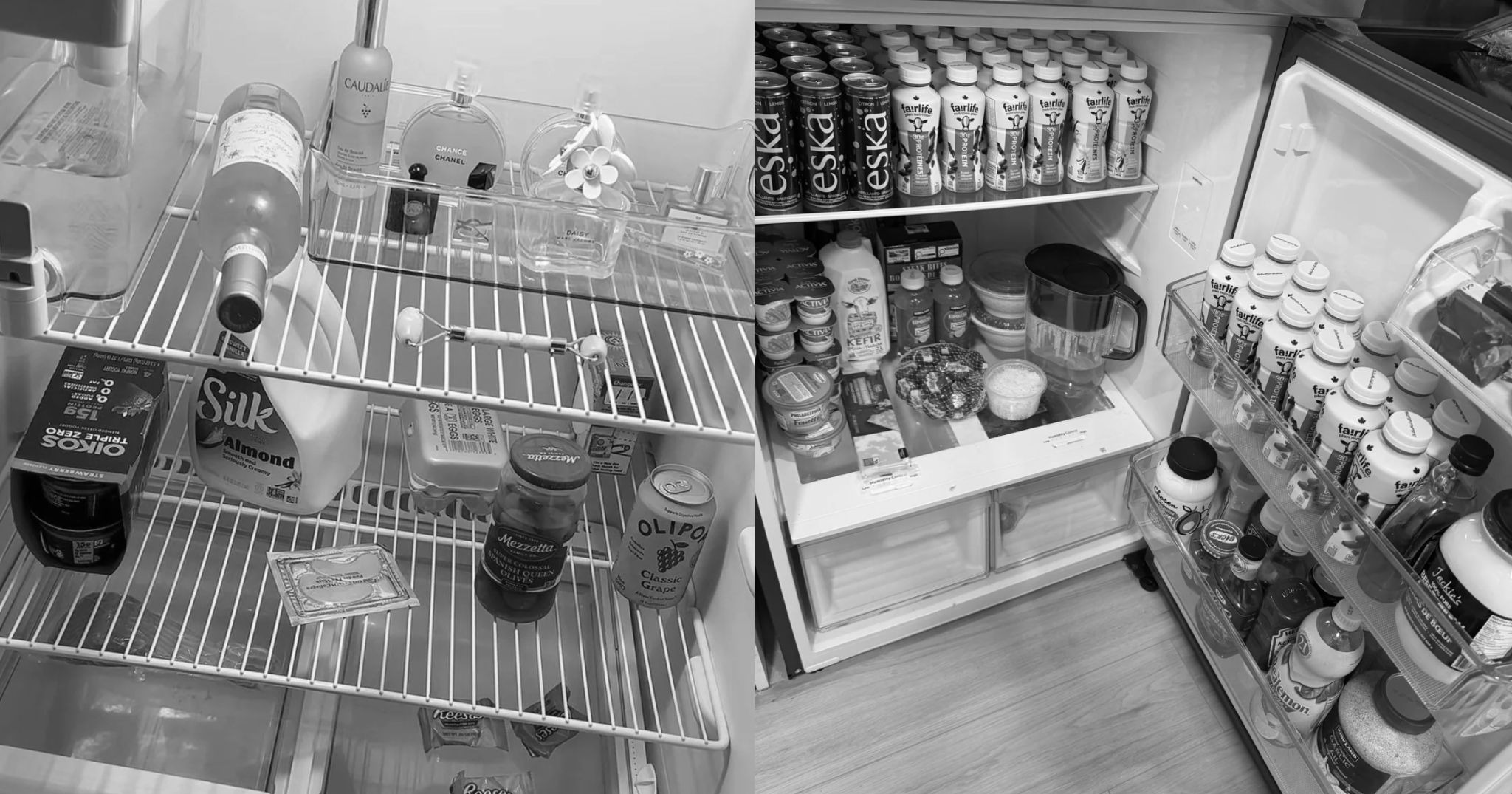
I think about this a lot in the context of creative work. Not fridges, silly. The principle underneath: that what you gather, save, bookmark, photograph, tear out, screenshot and return to is an honest portrait of your creative mind. More honest than a portfolio. More honest than a slick case study. I have this visual of a giant collage slowly assembling itself in the background of your life, made up of every fragment that caught your attention when you weren't trying to catch anything. It's built from specific things you noticed.
The problem is that most of this collecting happens passively. Inspiration washes over us through manicured feeds and screens and conversations. A small slice of it sticks. But we rarely ask why. So what happens when you start looking on purpose?
I do that through a weekly newsletter I write called Three Curious Things. Every week I pluck three items out of the internet from across art, design, branding, culture, language and technology that caught my attention. The discipline is not the finding. It's the asking: what about this specific thing makes it worth collecting for me? That question, repeated week after week as an act of meditation with eyes wide open and music blasting, turns passive noticing into something deliberate.
Here’s what I found about my creative self through almost two years of doing this. When I browse with no assignment in front of me, I gravitate toward a specific kind of work: grainy; textural; experimental. The kind of projects that feel like they're subtly refusing to cooperate. I like to think of myself as rebellious, but when I look at the references I reach for on real projects, they tell a different story. Photographic. Bold. Clean. Playful. Vibrant. Minimalist when it counts. A completely different set of instincts.
The practice of collecting hasn’t just built a reference library. It’s shown me that the creative person I want to be is not the creative person I am. The actual version of me is more interesting than the aspirational one, because it’s specific to me rather than borrowed from someone I admire.
This is where it gets useful for anyone who works in branding.
A brand is a cluster of associations. We all know that by now, and if you don't, LinkedIn has no shortage of thought leadership to catch you up. But in practice, when someone says a brand "feels premium" or "feels scrappy" or "feels like it was built by people who actually care," they aren’t describing a logo or a color palette. They’re describing the accumulation of small cues that, taken together, produce a feeling. The logo doesn’t do that. The feeling does. The logo just shows up to take credit.
Think of it like a piano. Every association is a note. The more notes you know, the more you can compose. You can play into expectations when you want to and subvert them when you need to. You know what chord the audience is already hearing, which means you know exactly where to introduce dissonance or harmony.
Most brand teams build their reference libraries from inside the category. Need to understand how a fintech should sound? Look at fintech. Need a visual direction for a B2B SaaS company? Look at B2B SaaS. Efficient. Also how you end up with forty companies that all look and sound like inbred cousins. The category can show you the expected notes. It can’t show you what the brand could uniquely feel like. For that, you need notes the category hasn’t played yet.
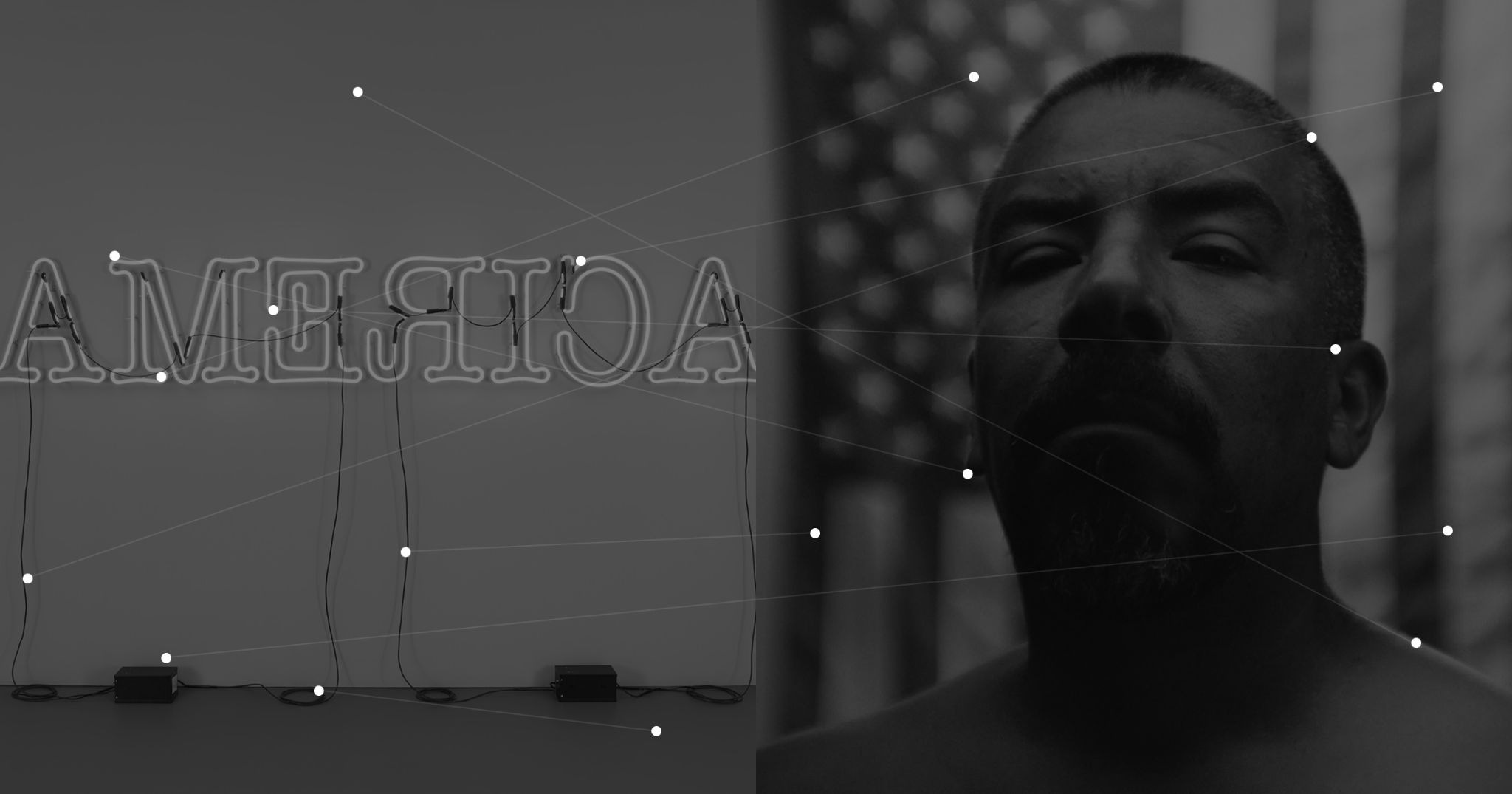
In 2018, we worked on a project for Lyft called "America's an Idea." Reframing what it means to be American. Released on the Fourth of July.
Immigration legislation was accelerating and the political temperature was high. We came to Lyft with a stat that reframed the stakes: over fifty percent of their drivers were immigrants or first-generation Americans. Every policy conversation about immigration had their company directly in the frame. And eighty percent of their rides were happening in the ten largest American cities, places where the lived experience of what America looks and feels like had already evolved well past the postcard version.
The obvious references would have been documentarian, journalistic or editorial. Perfectly respectable. But the creative key came from somewhere else entirely.
Glenn Ligon has spent decades making art about the word "America." Not the place exactly, but the idea of it. The weight the word carries and the ways it fails to hold together under examination. His neon works take a medium already soaked in Americana and use it to interrogate the country it advertises. In Rückenfigur, the word AMERICA is spelled in neon but the letters face the wall. You can read it and it's turned away from you at the same time. A country that, as one critic put it, is simultaneously addressing you and showing you its back.
Neon already carries a very specific version of America in people's heads - the motel sign; the diner; the roadside bar; the strip mall at the edge of town. Public, commercial, nostalgic, electric, slightly artificial and seductive in a way that feels both honest and performed. Ligon understood that. He played those familiar notes to ask harder questions about the country. We played them to recompose the picture.
If we've associated being American with a barbecue in the backyard, now we're seeing Korean pit masters. If we've associated it with Ford and the open highway, now it's Tesla and a rideshare. The image of America that was set in people's heads decades ago is still true. It’s also incomplete. The project's job was to update it, not replace it.
None of that came from studying the rideshare category. It came from an artist who had been sitting in the collage for months, waiting for the right brief to make him useful.
Here is a smaller example of the same pattern.
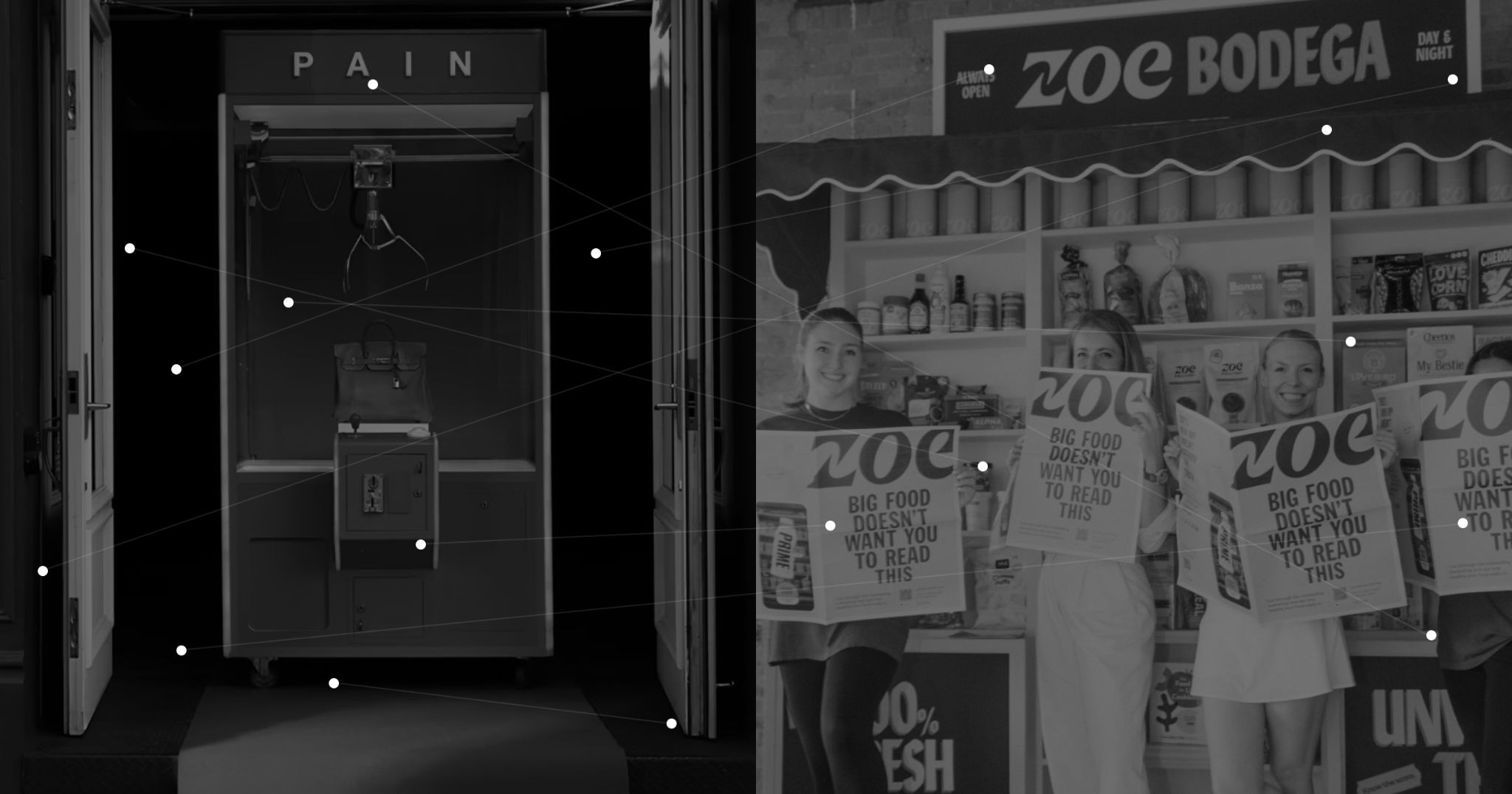
Uncommon built an art installation in SoHo a while back. A claw machine called Pain. Inside was a Birkin bag. You could play, but you couldn’t win. The claw would grab, almost grip and release. Every time. That was the piece. Aspiration as a rigged game, staged inside a format everyone already knows from boardwalks and bowling alleys. Literally painful. Yet, people lined up.
I covered it in Three Curious Things. Filed it away. Months later, we were working on an experiential activation for Zoe, a health and wellness app: a traveling bodega at influencer events where people could scan products and see how they scored. A live product demo dressed up as a cultural experience. I didn’t sit down and think, "that claw machine is relevant here." The connection surfaced because the reference was already in the library. Uncommon had turned a familiar format into something that carried a deeper message, and that had quietly changed how I was thinking about experiential work without my planning for it to.
That is what the network does. You can’t always trace the chain. Sometimes you can't even see the chain. But the more associations you have collected, the more unexpected connections become available. The instrument gets richer. The compositions get less predictable.
There’s a word the creative industry uses for all of this: taste. Taste is treated as something private and almost mystical. You have it or you don't. It’s your moat. Your competitive advantage. The thing that justifies your day rate.
I’m not sure that taste is that mysterious. If you follow the thread of this essay back, what you find underneath taste is a record: what someone notices, collects, questions, connects to and sits with over time. There’s something almost unsettling about that for a creative person; the idea that your secret sauce can be traced, mapped and maybe even taught. That it is not a private gift but an accumulated practice. Not a superpower. A habit.
But I think that makes it more interesting, not less. Because it means the practice of paying attention is not about becoming more inspired. It’s about expanding the instrument you compose with. Adding notes. Filling the collage with fragments that do not yet have a purpose, and trusting that the network will surface its own connections when the brief arrives.
Direct references show you the category. Indirect references reveal the feeling. And the feeling is usually where the brand lives.
Your fridge already knows who you are. Your collage might too, if you let it.
Shachar Aylon is a creative director and brand strategist with over fifteen years in tech. He's the founder of Dawn, a brand studio for companies that have evolved past the story they're still telling. He also writes Three Curious Things, a weekly newsletter about the interesting things hiding in plain sight across art, culture and brands.
One of my favorite subreddits is called Fridge Detective. Someone uploads a photo of their open fridge, and the community tries to guess who they are. Married or single? Gym rat or Swiftie? Where they live; what they do; what they care about. It sounds like a party trick, but the accuracy is unnerving. A fridge lined with Gatorade and Core Power protein shakes tells one story. A French-door fridge with yogurt pouches, farmers market broccoli and dinosaur-shaped chicken nuggets tells a very different one. Ask someone to describe themselves and they'll fumble for answers. One picture of what they collect and you already know.
I think about this a lot in the context of creative work. Not fridges, silly. The principle underneath: that what you gather, save, bookmark, photograph, tear out, screenshot and return to is an honest portrait of your creative mind. More honest than a portfolio. More honest than a slick case study. I have this visual of a giant collage slowly assembling itself in the background of your life, made up of every fragment that caught your attention when you weren't trying to catch anything. It's built from specific things you noticed.
The problem is that most of this collecting happens passively. Inspiration washes over us through manicured feeds and screens and conversations. A small slice of it sticks. But we rarely ask why. So what happens when you start looking on purpose?
I do that through a weekly newsletter I write called Three Curious Things. Every week I pluck three items out of the internet from across art, design, branding, culture, language and technology that caught my attention. The discipline is not the finding. It's the asking: what about this specific thing makes it worth collecting for me? That question, repeated week after week as an act of meditation with eyes wide open and music blasting, turns passive noticing into something deliberate.
Here’s what I found about my creative self through almost two years of doing this. When I browse with no assignment in front of me, I gravitate toward a specific kind of work: grainy; textural; experimental. The kind of projects that feel like they're subtly refusing to cooperate. I like to think of myself as rebellious, but when I look at the references I reach for on real projects, they tell a different story. Photographic. Bold. Clean. Playful. Vibrant. Minimalist when it counts. A completely different set of instincts.
The practice of collecting hasn’t just built a reference library. It’s shown me that the creative person I want to be is not the creative person I am. The actual version of me is more interesting than the aspirational one, because it’s specific to me rather than borrowed from someone I admire.
This is where it gets useful for anyone who works in branding.
A brand is a cluster of associations. We all know that by now, and if you don't, LinkedIn has no shortage of thought leadership to catch you up. But in practice, when someone says a brand "feels premium" or "feels scrappy" or "feels like it was built by people who actually care," they aren’t describing a logo or a color palette. They’re describing the accumulation of small cues that, taken together, produce a feeling. The logo doesn’t do that. The feeling does. The logo just shows up to take credit.
Think of it like a piano. Every association is a note. The more notes you know, the more you can compose. You can play into expectations when you want to and subvert them when you need to. You know what chord the audience is already hearing, which means you know exactly where to introduce dissonance or harmony.
Most brand teams build their reference libraries from inside the category. Need to understand how a fintech should sound? Look at fintech. Need a visual direction for a B2B SaaS company? Look at B2B SaaS. Efficient. Also how you end up with forty companies that all look and sound like inbred cousins. The category can show you the expected notes. It can’t show you what the brand could uniquely feel like. For that, you need notes the category hasn’t played yet.
In 2018, we worked on a project for Lyft called "America's an Idea." Reframing what it means to be American. Released on the Fourth of July.
Immigration legislation was accelerating and the political temperature was high. We came to Lyft with a stat that reframed the stakes: over fifty percent of their drivers were immigrants or first-generation Americans. Every policy conversation about immigration had their company directly in the frame. And eighty percent of their rides were happening in the ten largest American cities, places where the lived experience of what America looks and feels like had already evolved well past the postcard version.
The obvious references would have been documentarian, journalistic or editorial. Perfectly respectable. But the creative key came from somewhere else entirely.
Glenn Ligon has spent decades making art about the word "America." Not the place exactly, but the idea of it. The weight the word carries and the ways it fails to hold together under examination. His neon works take a medium already soaked in Americana and use it to interrogate the country it advertises. In Rückenfigur, the word AMERICA is spelled in neon but the letters face the wall. You can read it and it's turned away from you at the same time. A country that, as one critic put it, is simultaneously addressing you and showing you its back.
Neon already carries a very specific version of America in people's heads - the motel sign; the diner; the roadside bar; the strip mall at the edge of town. Public, commercial, nostalgic, electric, slightly artificial and seductive in a way that feels both honest and performed. Ligon understood that. He played those familiar notes to ask harder questions about the country. We played them to recompose the picture.
If we've associated being American with a barbecue in the backyard, now we're seeing Korean pit masters. If we've associated it with Ford and the open highway, now it's Tesla and a rideshare. The image of America that was set in people's heads decades ago is still true. It’s also incomplete. The project's job was to update it, not replace it.
None of that came from studying the rideshare category. It came from an artist who had been sitting in the collage for months, waiting for the right brief to make him useful.
Here is a smaller example of the same pattern.
Uncommon built an art installation in SoHo a while back. A claw machine called Pain. Inside was a Birkin bag. You could play, but you couldn’t win. The claw would grab, almost grip and release. Every time. That was the piece. Aspiration as a rigged game, staged inside a format everyone already knows from boardwalks and bowling alleys. Literally painful. Yet, people lined up.
I covered it in Three Curious Things. Filed it away. Months later, we were working on an experiential activation for Zoe, a health and wellness app: a traveling bodega at influencer events where people could scan products and see how they scored. A live product demo dressed up as a cultural experience. I didn’t sit down and think, "that claw machine is relevant here." The connection surfaced because the reference was already in the library. Uncommon had turned a familiar format into something that carried a deeper message, and that had quietly changed how I was thinking about experiential work without my planning for it to.
That is what the network does. You can’t always trace the chain. Sometimes you can't even see the chain. But the more associations you have collected, the more unexpected connections become available. The instrument gets richer. The compositions get less predictable.
There’s a word the creative industry uses for all of this: taste. Taste is treated as something private and almost mystical. You have it or you don't. It’s your moat. Your competitive advantage. The thing that justifies your day rate.
I’m not sure that taste is that mysterious. If you follow the thread of this essay back, what you find underneath taste is a record: what someone notices, collects, questions, connects to and sits with over time. There’s something almost unsettling about that for a creative person; the idea that your secret sauce can be traced, mapped and maybe even taught. That it is not a private gift but an accumulated practice. Not a superpower. A habit.
But I think that makes it more interesting, not less. Because it means the practice of paying attention is not about becoming more inspired. It’s about expanding the instrument you compose with. Adding notes. Filling the collage with fragments that do not yet have a purpose, and trusting that the network will surface its own connections when the brief arrives.
Direct references show you the category. Indirect references reveal the feeling. And the feeling is usually where the brand lives.
Your fridge already knows who you are. Your collage might too, if you let it.
Shachar Aylon is a creative director and brand strategist with over fifteen years in tech. He's the founder of Dawn, a brand studio for companies that have evolved past the story they're still telling. He also writes Three Curious Things, a weekly newsletter about the interesting things hiding in plain sight across art, culture and brands.